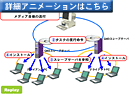
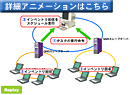
Either in WAN environments or if there are a lot of client machines, one "master server" can be set up, while multiple "slave servers" can be configured by business area. This will alleviate either load on network or load on servers.
< In distribution >
In distributing the modules, you may either schedule distributing them in a CD-ROM image to each slave server, or send CD-ROM itself to be set in the drive of each slave server.
QND Master server orders each client to install an install image from one of slave servers, and client machines then search their servers for the install image.
It would be an overload on the network if the master server directly distributes modules to the clients. By passing through slave servers, you can disperse the load.
*
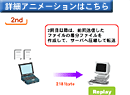
QND multicast is effective to disperse the load in case file trasmission is done within the same segment.
< When collecting client computer data (inventory) >
If collecting inventory data from the client at the same occation, it may impose overload on the network.
You can temporarily stock client data in slave servers, then import it to the master server in order by proper schedule. So you can disperse the load on the network.